
First Edition · Manuscript complete · Publication forthcoming
From first file review to a filing-ready motion to reopen.
A motion to reopen must show why the law permits it.
The record must show why the court should act.
“I highly recommend The EOIR Motion to Reopen Practice Manual to immigration practitioners. Although the main thrust of this book is for defense counsel, it will prove to be equally valuable to Department of Homeland Security prosecutors and immigration judges.”
The Hon. Marna M. Rusher (Ret.) — from the Foreword
Built from the author’s work on more than 160 motions to reopen, drafted in collaboration with U.S. immigration attorneys and law firms.
The scale of the work
54,557 motions to reopen
in one fiscal year.
EOIR recorded 54,557 Immigration Court motions to reopen in FY2025 — nearly 87% more than in FY2023.

Source: EOIR Adjudication Statistics, "Motions," data generated July 24, 2026. justice.gov/eoir
311,130
In absentia removal orders
issued in FY2025.
An in absentia removal order is not
subject to direct appeal; rescission
proceeds by motion to reopen.
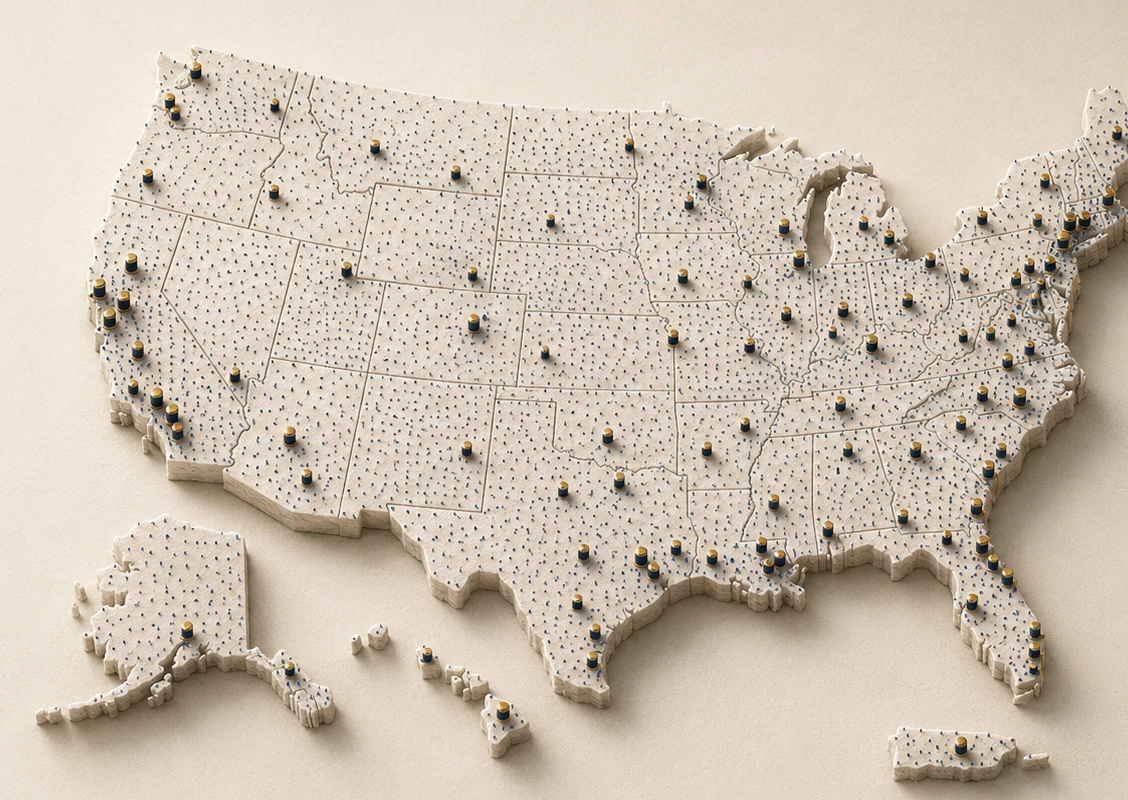
Built from the author’s work on more than 160 motions to reopen, drafted in collaboration with U.S. immigration attorneys and law firms.
Free preview
See the actual book before it is published.
Browse the complete Table of Contents and read a selected passage reproduced from the current manuscript.
Selected reading · Chapter 2, § 2.9
Strategic Considerations in Multi-Ground Motions
- The complete Table of Contents, exactly as it appears in the current manuscript
- Six consecutive pages of § 2.9 — when reopening grounds combine, where pairings break down, and the D-E-B- supplement trap
- The manuscript’s own typography, citations, footnotes, and practice notes
Grounds are compatible only if one theory does not contradict or undermine the facts supporting another.
— from § 2.9.1, The Factual-Consistency Test
Read on this site · a selected passage, not a complete chapter
Inside the motion chapters — Chapter 5, IAC / Lozada
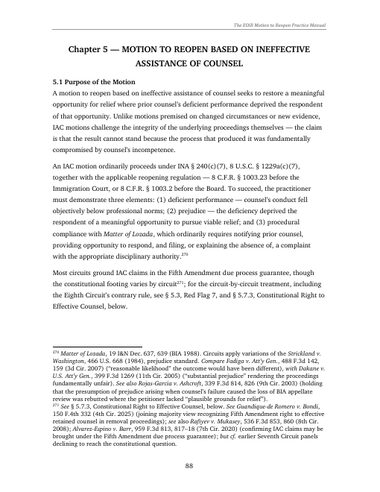
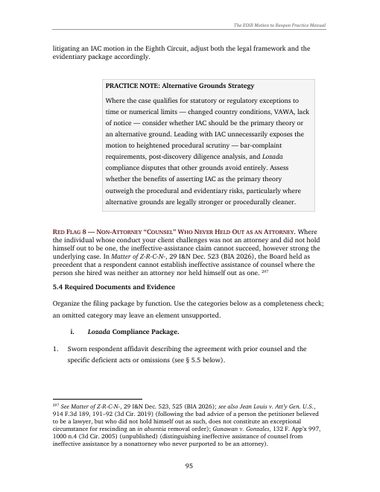
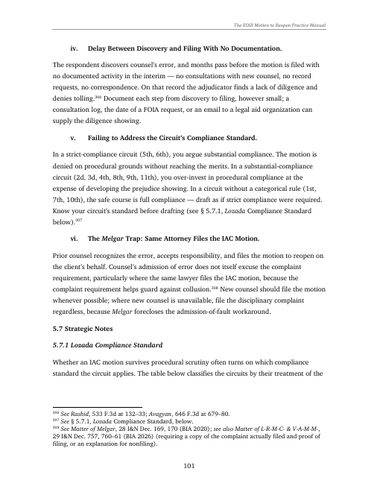
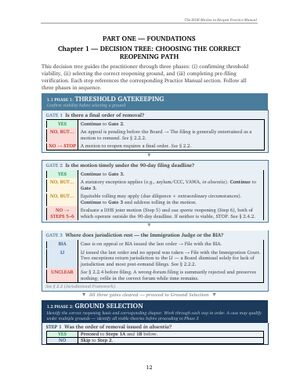
Actual pages from the manual, shown at reading distance. The full treatment — verified authorities, checklists, and circuit classification — is in the complete edition.
The preview shows one strategic section. The manual develops every motion chapter in full depth. Browse the complete Table of Contents →
New to motions to reopen? Read the practitioner orientation →
What’s inside
A Disciplined System for EOIR Motions to Reopen
12chapters
3parts
7motion-specific chapters
Chapters 3 through 8 follow the same recurring framework — purpose, threshold screening, strategic risk assessment, required documents and evidence, affidavit guidance, common failure points, and strategic notes. Chapter 9, the Calderon Jimenez settlement framework, follows its own specialized structure. A motion may look persuasive and still fail; the framework exists to catch what sinks filings.
01
Defective Notice & In Absentia
Challenge improper service, defective NTAs, and in absentia orders with verified authority chains.
02
Exceptional Circumstances
Build compelling showings with the evidentiary standards that actually hold up.
03
IAC / Lozada Framework
Lozada’s three-prong compliance, circuit-specific relaxation standards, and Fifth Amendment grounding.
04
VAWA
Special filing rules, confidentiality protections, and evidentiary frameworks for VAWA-based motions.
05
New Evidence & Changed Country Conditions
New-evidence standards, change-in-law grounds, and country-condition documentation strategies.
06
Sua Sponte Reopening
When deadlines have passed — the adjudicator’s inherent authority and the governing circuit split.
07
Calderon Jimenez (Joint Motions)
The time-limited class-action settlement framework for government-agreed reopening.
Three parts wrap the grounds — the decision tree and universal motion requirements up front; evidence assembly, filing mechanics, and fees at the back; plus appendices, a Table of Authorities, and a Topical Case Index. Authorities reviewed for currency through July 22, 2026.
Why it exists
Built for how removal defense actually moves
Motion practice leaves little room for preventable error.
Deadline traps
The manual organizes the principal deadlines, statutory exceptions, equitable-tolling questions, and numerical limitations so they can be addressed before drafting begins.
Circuit-specific standards
Compliance, prejudice, equitable tolling, and reviewability vary by circuit. The manual identifies those differences and ties them to the governing authorities.
Authorities reviewed for currency
The statutes, regulations, agency materials, Board decisions, and circuit authorities cited in this edition were reviewed through July 22, 2026. Practitioners must still confirm current law and applicable filing requirements before relying on any authority.
Foreword
Foreword by Hon. Marna M. Rusher, Retired Immigration Judge
“I have had the pleasure of knowing and working with Julio Costa, and I have watched firsthand his development in immigration law. It is therefore with particular pride that I write this foreword to The EOIR Motion to Reopen Practice Manual.”
The Hon. Marna M. Rusher (Ret.) — from the Foreword
About the author

Julio Costa, LL.M.
Brazilian attorney · legal consultant collaborating with U.S. immigration attorneys and law firms
15+Years of Litigation Experience in Brazil
160+Motions to Reopen Drafted in Collaboration with U.S. Immigration Attorneys
60+Appellate Briefs Drafted for BIA Proceedings
Practitioner endorsements
What practitioners say about the Manual
a clear, structured framework
“What distinguishes this manual is its practical approach. Rather than simply explaining the law, Julio Costa provides attorneys with a clear, structured framework for evaluating cases, avoiding common pitfalls, and preparing well-supported, filing-ready motions to reopen. This is the kind of resource practitioners will turn to again and again in their daily practice.”
reduce critical errors
“A highly structured and practice-oriented resource that helps practitioners organize their strategic analysis and reduce critical errors in Motions to Reopen, which are notoriously complex. I see it as a valuable tool for both internal standardization and team training.”
a rare combination of deep legal knowledge and real-world experience
“I had the opportunity to read part of this book before its publication and was genuinely impressed by the quality of the work. The author has succeeded in turning a complex subject into a clear, practical, and highly valuable resource for immigration practitioners. It is a rare combination of deep legal knowledge and real-world experience. I have no doubt this book will become an important reference for attorneys and other professionals who practice before the EOIR. I highly recommend it.”
an exceptional grant rate
“Julio achieved an exceptional grant rate on motions to reopen before both the Immigration Court and the BIA. His work was consistently delivered with clarity, accuracy, and efficiency — and he never missed a deadline.”
drafts and reviews legal documents with precision
“Mr. Costa drafts and reviews legal documents with precision. His deep understanding of immigration law, particularly removal proceedings, was instrumental in delivering high-quality legal services.”
Planned editions
Two editions at publication
The Manual
The complete reference system for EOIR motions to reopen.
- All seven motion-specific chapters, element by element
- Filing framework & decision tree
- Recurring ground-specific framework
- Circuit-split analysis tables
- Topical case index & reference matrix
The Manual + Template Pack
Everything in the Manual, plus editable templates and practice tools that must be adapted to the record, governing law, and procedural posture.
- Everything in The Manual
- Pre-filing assembly checklist
- Lozada / Melgar compliance checklist
- Quick-reference motion matrix
- Editable document templates
Pricing announced at publication
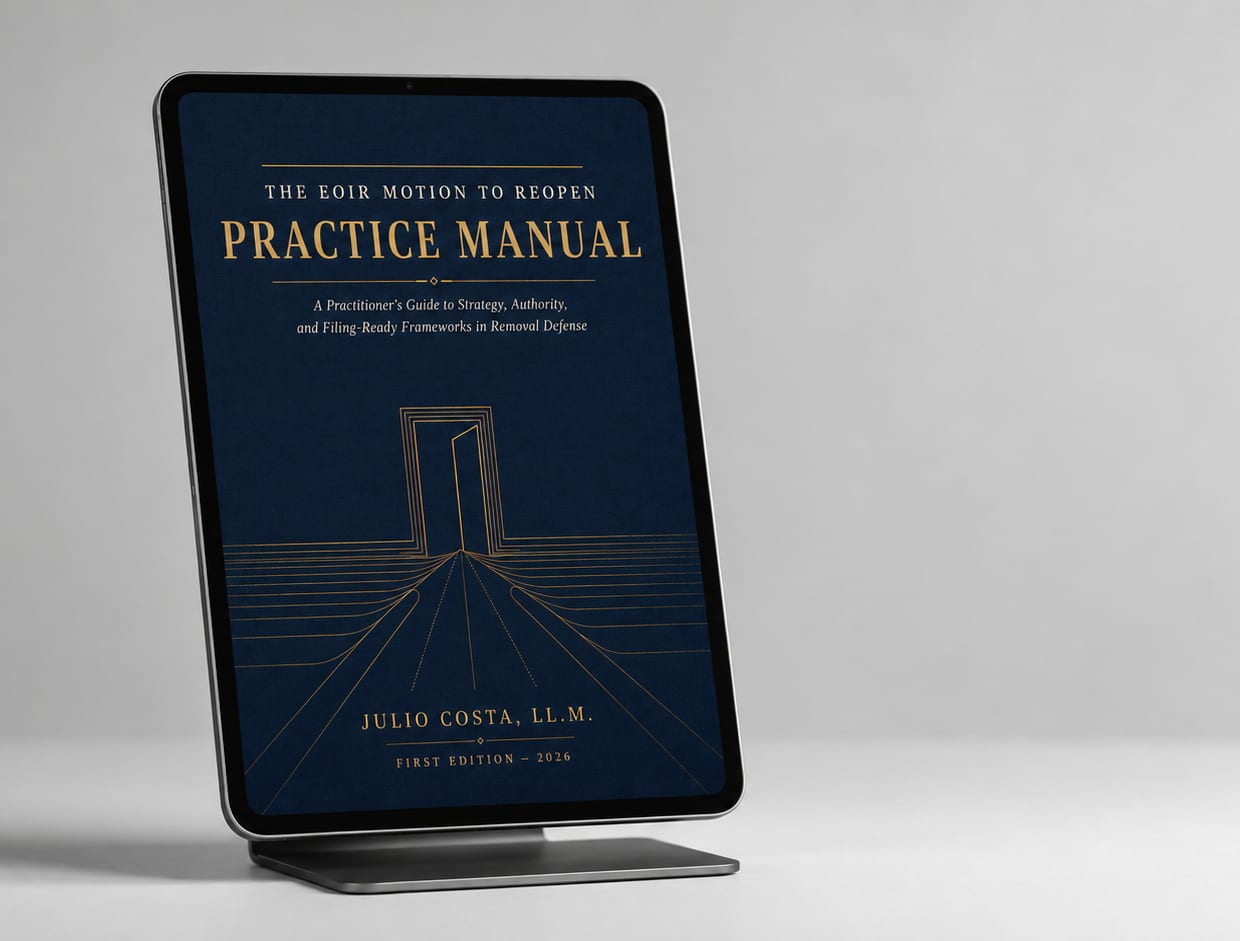
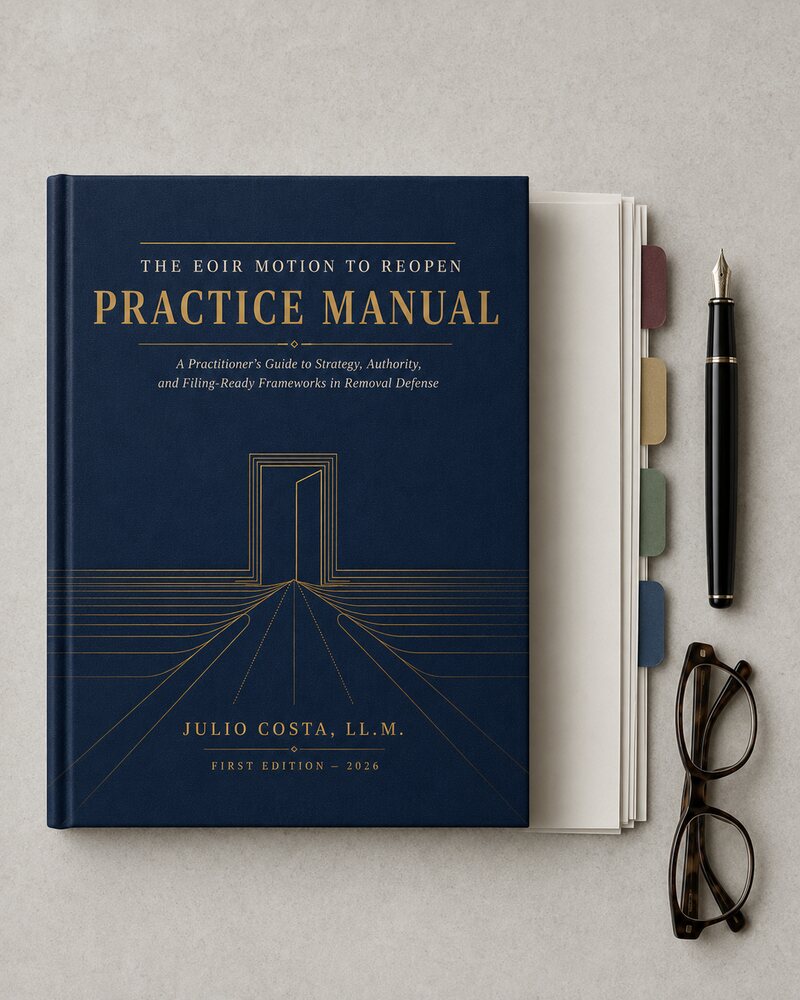
Every individually issued digital copy is personalized with a unique Copy ID and recorded in a distribution ledger.
Publication notice
Join the launch list to receive one notice when the manual is published, with pricing and both editions.
After confirming your address, you will receive one publication notice when the manual is released. Unsubscribe anytime · privacy.