Free preview
Open the Free Preview
Browse the complete Table of Contents and read a selected passage reproduced from the current manuscript.
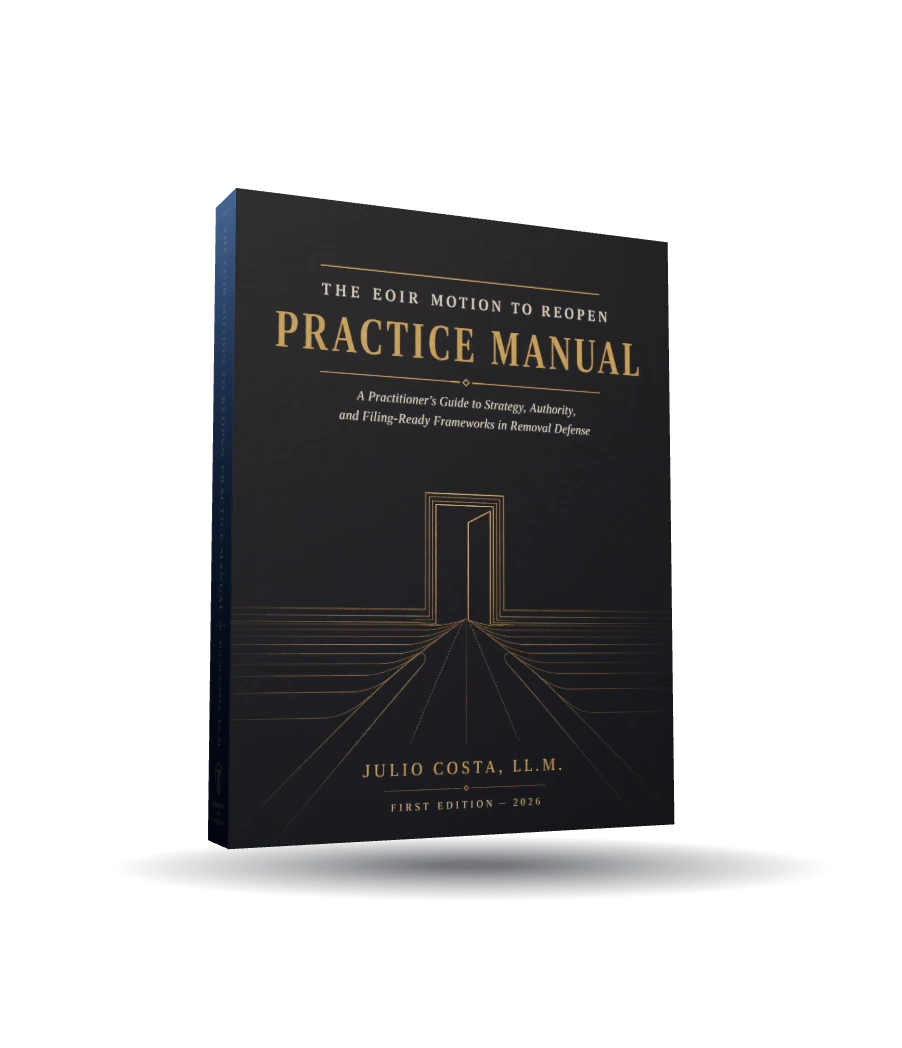
What the preview contains
- The book’s preliminary pages — copyright & disclaimer, currency of authorities (July 22, 2026), about the author
- The complete Table of Contents, exactly as it appears in the current manuscript
- § 2.9, Strategic Considerations in Multi-Ground Motions — six consecutive pages, with the manuscript’s own typography, citations, footnotes, and practice notes
Grounds are compatible only if one theory does not contradict or undermine the facts supporting another.
— from § 2.9.1, The Factual-Consistency Test
Read on this page · a selected passage, not a complete chapter · no email required


The preview shows one strategic section of Chapter 2. The complete manual develops every motion chapter in full depth — browse the complete Table of Contents.
The excerpt as text
An accessible text edition of the selected reading, § 2.9 of the manual, for screen readers and search. The page images above show the passage in the book’s own typography; footnotes are collected at the end with the manual’s numbering.
2.9 Strategic Considerations in Multi-Ground Motions
2.9.1 Raise All Viable Grounds: The Factual-Consistency Test
Assert every reopening ground supported by the record and applicable law. A motion need not be limited to one theory when multiple viable bases exist. Before combining grounds, compare their factual premises. Grounds are compatible only if one theory does not contradict or undermine the facts supporting another. Before pairing grounds, identify:
- The factual predicate for each ground. What specific facts must be true for this ground to succeed?
- Points of factual tension. Do the factual predicates conflict? Does asserting one fact pattern weaken or contradict another?
- Primary versus alternative designation. If the grounds rest on mutually exclusive facts, they can be raised as alternatives (“either X is true, or if the Court finds Y, then Z applies”) rather than as cumulative arguments.
- Structural clarity. Can the motion present each ground in a way that allows the adjudicator to rule on them independently?
2.9.2 Pairing Grounds: What Works and Why
Compatible pairings share a factual core or address analytically distinct elements of the case. The pairings below appear regularly in reopening practice because their factual predicates do not contradict each other. For each, the discussion explains why the pairing works, identifies the factual line that must be maintained, and flags where the pairing breaks down.
Defective Notice + Ineffective Assistance of Counsel
Why it works. These grounds address analytically distinct failures. The notice claim challenges whether the respondent received valid service. The IAC claim explains counsel’s role in creating or perpetuating the service defect. When counsel’s error is what caused the notice to go to the wrong place, both theories target the same underlying problem from different angles.
How to frame it. The pairing is strongest where counsel’s error contributed to a genuine defect in service — for example, by failing to file an EOIR-28 entry of appearance, failing to update the respondent’s address with the court, or providing incorrect address information, resulting in the hearing notice being sent to a stale or wrong address. In that posture, the notice claim challenges the validity of service itself, while the IAC claim explains counsel’s role in creating the defect and, where necessary, supports tolling of the filing deadline.
Where it breaks down. If notice was properly served on counsel of record and counsel merely failed to inform the client, the stronger theory is usually ineffective assistance rather than statutory lack of notice.179 After the Supreme Court’s decision in Campos-Chaves v. Garland, a respondent who received a compliant hearing notice for the hearing he missed cannot rescind on notice grounds — which, as a matter of practice, pushes counsel-failure cases out of the notice lane and into the exceptional-circumstances/IAC lane. Framing the claim as counsel failure rather than a notice defect where notice was validly served is the practitioner’s strategic inference, not a holding of Campos-Chaves. The line is between a defect in service (notice theory) and a failure to act on valid service (IAC theory).
Exceptional Circumstances + Equitable Tolling
Why it works. These grounds address two different questions. Exceptional circumstances explains why the respondent failed to appear at the hearing. Equitable tolling explains why the motion to reopen was not filed within the statutory deadline. They operate on separate timelines and do not require overlapping factual predicates.
How to frame it. Example: the respondent was hospitalized on the day of the hearing (exceptional circumstances), retained new counsel within a reasonable period, but counsel failed to timely file the motion within 180 days (equitable tolling based on Lozada — viable on circuit authority, but see § 2.3.2 on the Board’s position that the 180-day deadline itself is not extended on IAC grounds).180 The exceptional-circumstances showing addresses the nonappearance; the tolling showing addresses the late filing. Each ground stands independently.
Where it breaks down. If the tolling claim rests on the same factual predicate as the exceptional-circumstances claim — for example, “I was too sick to attend and too sick to file” — the motion must explain the full timeline with precision. The adjudicator will want to know when the exceptional circumstance ended, when the respondent became capable of acting, and what happened during the intervening period. Vague or conclusory timeline assertions weaken both grounds.
Primary Ground + Sua Sponte Request
Why it works. Sua sponte reopening is not dependent on specific factual predicates. It is a discretionary authority that the Board and Immigration Judges may exercise at any time, without regard to the time and number limitations applicable to party-filed motions.181 Because sua sponte reopening rests on the adjudicator’s own discretion rather than on a required factual showing, it rarely conflicts with the statutory or regulatory grounds raised in the same motion — though the request must still identify the equities that make the case exceptional (below), and an adjudicator may read a fallback request as hedging where the primary ground is thin.
How to frame it. Present the statutory or regulatory ground as the primary basis for reopening, fully briefed with all required elements. Then include a clearly labeled alternative request asking the court to exercise sua sponte authority in the event the primary ground is denied. The sua sponte request should identify the equities that make the case exceptional — length of residence, family ties, rehabilitation, pending collateral relief, or other circumstances that distinguish the case from routine reopening practice.
Limits of the request. The Board has repeatedly characterized sua sponte reopening as an “extraordinary remedy” reserved for “exceptional situations” (see § 2.4.2, Category 3). Include the request as an alternative in a multi-ground motion when warranted, but do not rely on it to cure a weak primary ground.
2.9.3 The Supplement Trap: When a Later Filing Becomes a Separate Motion
Multi-ground practice also presents a separate risk: a later filing may be treated as a new motion rather than as a supplement. In Matter of D-E-B-, the Board held that a supplemental filing to a motion to reopen that raises claims fundamentally different from those in the original motion is treated as a separate motion subject to independent compliance with time and number limitations.182 A later “supplement” that asserts a fundamentally different theory may be treated as a separate, untimely motion even when the original motion was timely.183 Practitioners should decide early in the case whether multiple theories belong in one integrated motion or must be presented as separate motions with independent procedural compliance. Where the theories are related and share a common factual core, they should be included in a single filing. Where they rest on fundamentally different factual and legal bases, the practitioner must either file them together at the outset or accept that a later filing will be evaluated as a standalone motion.
RED FLAG. The D-E-B- trap is most dangerous when a practitioner discovers a new ground for reopening after the original motion has already been filed — for example, a VAWA claim that emerges during the pendency of an IAC-based motion. If the new theory is fundamentally different from the original, attaching it as a “supplement” will not preserve the original filing date. The practitioner must assess whether the new theory can be filed as an independent motion within its own applicable deadline, or whether it must be raised through a different procedural vehicle.
2.9.4 Structural Requirements for Multi-Ground Presentation
When asserting multiple grounds, the motion must:
- Clearly designate primary and alternative grounds. If grounds are mutually exclusive factually, label them as alternatives (“In the alternative, if the Court finds...”).
- Organize grounds in separate sections with distinct headings. Do not blend arguments. Each ground should be independently comprehensible.
- Avoid buried alternative theories. If raising an alternative ground, it must be presented with the same level of development and citation as the primary ground — not as a single sentence or footnote.
- Maintain factual consistency within each ground. Do not make contradictory factual assertions within the same section or across sections unless explicitly designated as alternatives.
- Include all theories in the initial filing where possible. Under Matter of D-E-B-, a later “supplement” raising fundamentally different claims may be treated as a separate motion. Consolidate related theories in a single filing to avoid procedural fragmentation.
Notes
- 179.
- See Campos-Chaves v. Garland, 602 U.S. 447, 462 (2024) (holding that a noncitizen who received a compliant hearing notice specifying the time and place of the hearing cannot obtain rescission for lack of notice, even if the original NTA was defective). After Campos-Chaves, a claim that counsel failed to relay validly served notice is typically an ineffective-assistance theory, not a statutory lack-of-notice theory. For full treatment of the notice framework after Campos-Chaves and Matter of Laparra-Deleon, 29 I&N Dec. 389 (BIA 2026), see Chapter 3.
- 180.
- See Matter of Lozada, 19 I&N Dec. 637 (BIA 1988) (establishing the procedural framework for ineffective-assistance-of-counsel claims in immigration proceedings). For full treatment of the Lozada requirements, see Chapter 5.
- 181.
- See Matter of J-J-, 21 I&N Dec. 976 (BIA 1997) (holding that sua sponte reopening is a discretionary remedy not subject to the time and number limitations otherwise applicable to motions to reopen); Matter of G-D-, 22 I&N Dec. 1132 (BIA 1999) (describing sua sponte as an extraordinary remedy reserved for exceptional situations). For full treatment of sua sponte authority, see Chapter 8.
- 182.
- Matter of D-E-B-, 29 I&N Dec. 83 (BIA 2025) (“A supplemental filing to a motion to reopen that raises claims that are fundamentally different from those raised in the original motion is treated as a separate motion.”). In D-E-B-, the respondent filed a timely motion to reopen based on ineffective assistance of counsel and, over 18 months later, filed a “supplement” asserting a VAWA-based reopening theory. The Board held that the supplement was a separate, untimely motion.
- 183.
- See id. The risk is not factual inconsistency but procedural fragmentation. A “supplement” that introduces a fundamentally different theory does not relate back to the original filing date and must independently satisfy the time and number limitations.
Publication notice
Join the launch list to receive one notice when the manual is published, with pricing and both editions. Nothing else is sent.
After confirming your address, you will receive one publication notice when the manual is released. Unsubscribe anytime · privacy.